
How to sell digital products starts with a paid problem
To sell digital products, begin with a repeated problem, ship the smallest useful shortcut, and use every sale as new product evidence. The file can be reusable, but distribution, delivery, pricing, refunds, and support still form an operating loop.
See ecommerce workflows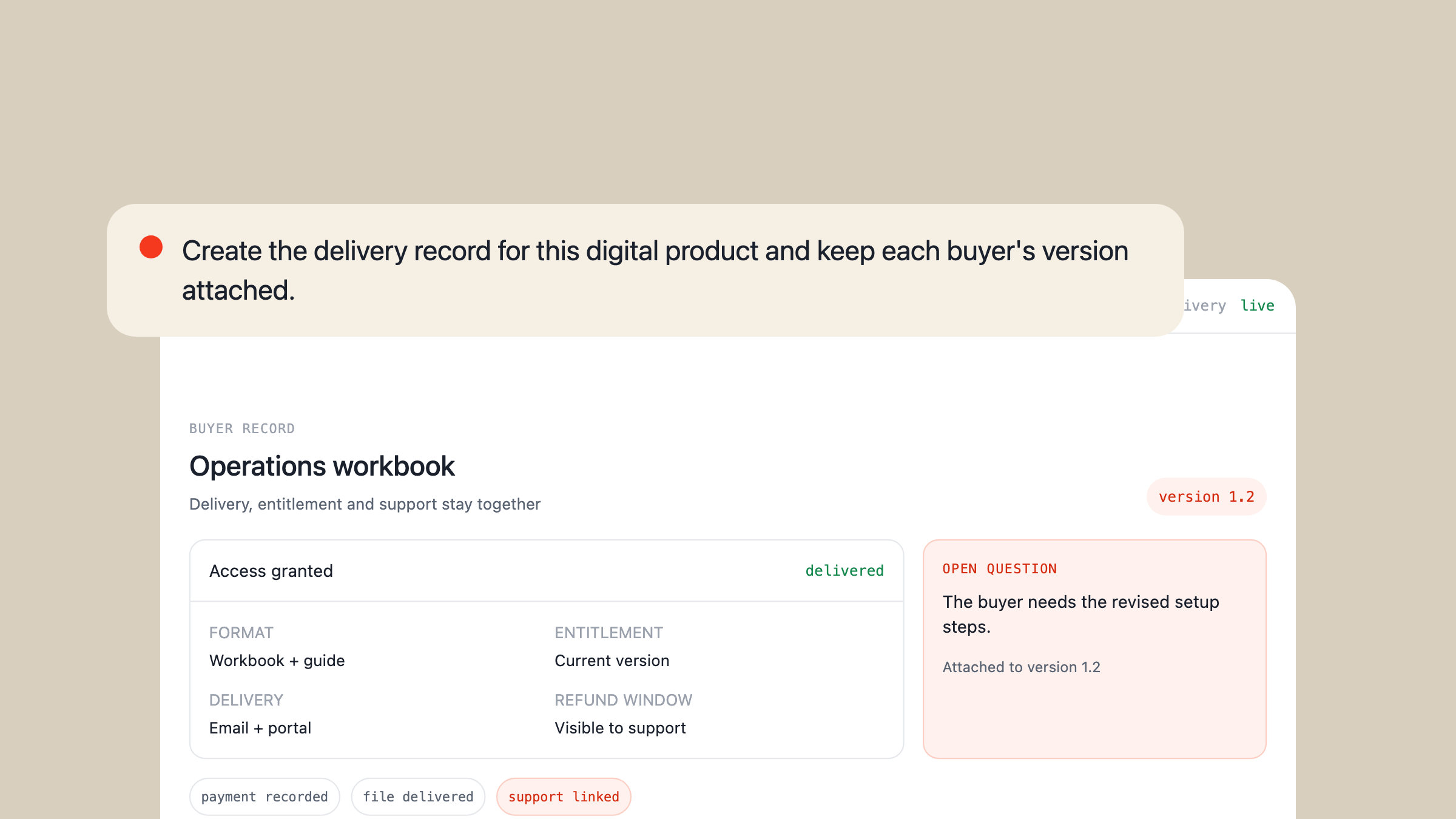
Find the question before you build the file
To sell digital products, start with a problem people already ask you to solve. Repeated questions are evidence that an outcome matters, that people cannot reach it alone, and that your answer may be worth packaging. A novel idea proves none of those things. Before choosing a format, collect the questions, requests, and pieces of work that keep returning.
Thomas Frank followed that trail through his audience. He said most of their questions concerned personal productivity, so he treated those questions as market research and built the template he wanted for himself. He first gave templates away, then created a paid version around the problem people had already shown him. By his account, that specialist audience and an email list helped the business reach a $100,000 month.
The useful part of Frank's story is not the revenue figure. That is his claim, not a forecast for a new seller. The useful part is the order of events. A defined audience asked related questions. Free tools exposed which parts of the answer people used. The paid product compressed those lessons into a more complete shortcut. Demand was visible before the file existed.
This changes what “product research” means. You do not need a survey asking whether somebody might buy an ebook, template, calculator, course, or download. Look for a task that people repeatedly ask you to explain, review, or do for them. Then identify the reusable part of your answer. The format comes after the job because the buyer wants progress, not a particular file type.
| Signal | What it proves | Smallest product candidate |
|---|---|---|
| The same question returns | The problem is understood | A short guide or decision tree |
| You repeat the same manual work | The process can be packaged | A template or calculator |
| People want a visible outcome | The finish line is concrete | A checklist or guided workflow |
Ryan Deiss reached a similar conclusion from an unlikely first product. He said he began with a 28-page baby-food ebook that he did not write, on a subject he did not personally practise. His lesson was to stop treating originality as the goal. The product still had to be useful and honestly presented, but the commercial signal was the existing problem, not whether nobody had ever packaged an answer before.
That is a better filter than asking which digital products are popular. A popular format can hide a weak reason to buy. A repeated problem gives you language for the promise, boundaries for the scope, and people who can react to an early version. If the question is broad, narrow it to one moment where the buyer gets stuck. “Become more productive” is vague. “Plan the coming week without rebuilding the system” can become a specific shortcut.
EP described the same path from the opposite direction. He said that giving away useful expertise created demand for a structured paid version. About 30 days after beginning to publish that expertise, he reported earning $37,500 in one day from the offer, with roughly 99% profit. Those figures are self-reported and unusually strong. What generalises is the mechanism: public teaching revealed which ideas attracted questions, while the paid product offered sequence, completeness, and less work for the buyer.
Start, then, with an evidence log rather than a product backlog. Record the exact questions people ask, the answer you repeatedly give, the part that consumes time, and the outcome they are trying to reach. Group questions that belong to the same job. The smallest useful group is your first product candidate. Originality can sharpen the presentation later. It cannot substitute for proof that the problem returns.
The smallest paid answer beats the complete one
Once you have a problem worth solving, make the first version smaller than your instinct suggests. Its job is to complete one useful outcome and expose what buyers do next. It does not need to contain everything you know.
Andrew learned this after spending a month on a complicated ebook outline without finishing the product. Andrew scrapped it, replaced it with a simple outline, and released a free ebook. In its first week, the ebook produced a reported 145 downloads and $76 in voluntary payments. The smaller version did something the elaborate plan could not: it reached real readers and returned evidence.
The before and after is useful because the topic did not need to change. The scope did. Before, the outline tried to anticipate every necessary chapter. After, the ebook only had to be coherent enough for somebody to finish and judge. The first version produced responses, payments, and a clearer audience. Another month spent expanding the outline would have produced none of those signals.
| Step | What you do | Where you stop |
|---|---|---|
| Choose | Name one completed outcome | Before adjacent problems |
| Make | Build the minimum useful artifact | When the outcome is repeatable |
| Test | Offer it to a small group | After real use and feedback |
A practical scope test is to finish this sentence: “After using this, the buyer can...” If the answer contains several verbs, split it. A guide that helps someone choose, build, launch, market, and support a product is five promises. A template that helps them calculate a viable price is one. The narrower promise makes the product easier to finish, explain, and evaluate.
Ebere Onyechere's first sale shows how little infrastructure a useful test may need. Onyechere reported selling a $7 digital product to 10 buyers in seven days with a small audience and no email list. That is not proof that every small audience will buy. It is proof that the first useful signal can arrive before a large audience, elaborate launch, or complete catalogue exists.
Reach alone is a weaker signal. Divv Saxena described a public explanation that drew broad attention, while reporting that the ebook behind it produced $534. The sales figure is self-reported, and broad attention does not reveal how many people saw an offer or wanted the promised outcome. The contrast still matters: attention and buying intent are different measurements. A smaller test placed in front of people with the problem can teach more than a large audience reacting to adjacent content.
Set the first version's boundary before you build it. Name the one outcome, list the minimum pieces required to reach it, and move every optional lesson into a later-version note. Then decide what evidence will count: a completed use, a question, a refund request, a voluntary payment, or a purchase. The product is ready for this test when a buyer can reach the promised finish line, not when you have exhausted the subject.
This is why scope is a test variable rather than a statement of ambition. A small product is not automatically useful, and a large one is not automatically complete. The right first product is the smallest shortcut that lets a buyer finish one meaningful job and lets you observe what remains difficult.
Distribution doubles as product research
Distribution should do more than send traffic to a checkout. A useful path lets you observe four things in sequence: what earns attention, which questions recur, whether a small artifact helps, and what people will pay for the fuller outcome. Each stage returns evidence that can change the product.
Florian Darroman described this loop clearly. He first built a public audience, then released a free ebook and collected 700 email subscribers. The next offer was a course. He reported 452 students and €30,215 in revenue within two weeks. Those numbers are his claims, not a formula. The sequence matters because each step created a closer signal than the one before it: attention, permission to follow up, then a purchase.
| Operator | Reported sequence | Learning returned |
|---|---|---|
| Josh Millgate | Public writing → 280 sales → over $7,500 in eight months | Which audience kept finding the templates |
| Florian Darroman | Public audience → free ebook → 700 emails → 452 students | Who moved from interest to a paid course |
| Salez | Public writing + Gumroad + Notion marketplaces → claimed $30,000 | Which mix joined credibility and checkout |
| Daniel Vassallo | New launches → cumulative sales from $29,000 to $343,000 | Growth arrived in launches, not a smooth line |
Josh Millgate's template business shows why a sustained path matters. He said an audience built through public writing was the primary source of traffic across eight months. During that period, he reported selling 280 templates for more than $7,500, with an average sale price of $19.20. The important observation is not that every seller should copy his channel. It is that one continuing source made the relationship between the audience, the offer, and the sales visible over time.
Salez used a wider version of the same loop. He combined public writing for credibility with a Gumroad page and every available Notion marketplace, then attributed $30,000 in template revenue to that combination. Those surfaces had distinct jobs. The writing showed the thinking behind the product, the marketplaces placed it near existing demand, and the product page handled the purchase. Together they formed one observable route rather than a disconnected collection of promotional tactics.
Build your route around that continuity. Publish a useful explanation where the intended buyer already pays attention. Offer a small artifact that helps them take one step and gives them a reason to stay in contact. Present the paid shortcut to the people who engaged with that problem. Then record the questions, objections, conversions, and non-conversions against the same promise. If each stage changes its audience, message, and outcome, you cannot tell what the product taught you.
Daniel Vassallo's cumulative record is a warning against expecting this route to become smooth. Over 15 reported months, his Gumroad sales rose from $29,000 to $343,000. His record marked new launches, and the visible jumps coincided with them. A reusable product can keep selling, but renewed attention and new offers still alter the curve.
Choose the narrowest distribution path that keeps attention, questions, proof, and checkout connected. Its efficiency is not the number of places carrying the link. It is how quickly a signal at one stage can improve the promise, format, or scope at the next.
Price the shortcut, not the page count
Three useful pricing cases disagree with one another. Nathan Barry earned more by adding tiers. Thomas Frank expanded his offer after customers requested more. HC raised the price of one product and said sales increased. None supports a universal rule that digital products should be cheap, expensive, or divided into three options.
Barry reported earning $37,000 in the first month of his first ebook. He offered three packages: the book with resources, another version with videos, and a complete package. He said those choices added about $15,000 compared with selling at one price. In his account, the upper packages did not merely rename the same file. They included a more complete way to reach the outcome.
Frank's sequence started with customer requests instead of a planned pricing ladder. He sold a $49 template, then introduced a $179 bundle in response to what buyers asked for. He said the bundle increased average order value. The larger offer made sense because the audience had already identified an unmet version of the job. The price followed an expanded product, not an arbitrary multiplier.
HC reported a different result. After raising a product's price from $2 to $9, sales increased. HC gave no sales count, so the claim cannot show the size of the change or establish an ideal price. It does challenge the assumption that the lowest possible price always removes friction. A very low price can communicate that the outcome matters little, even when the product is useful.
Taken together, the cases move the pricing question away from file length. Buyers do not receive value from the number of pages, videos, fields, or downloads. They receive value from reaching a desired result with less uncertainty, time, or repeated work. Price should reflect how consequential that result is, how completely the product helps produce it, and how much support the seller must provide.
This is why core, guided, and complete offers should represent different stakes. A core product can provide the reusable artifact. A guided product can add instruction that reduces uncertainty. A complete product can cover more of the path or include support. These distinctions are only honest when the buyer receives a materially different product. Three checkout cards with the same outcome and cosmetic bonuses are one product disguised as a choice.
Use buyer evidence to decide whether more than one offer exists. If customers ask for help applying the artifact, that may justify guidance. If they ask for related components required to finish the same job, that may justify a bundle. If they buy a simple product more readily after a price increase, test whether the old price understated its value. Each move changes a different variable, so combining them into a standard tier structure would hide what you are trying to learn.
Write the promise for each offer in one sentence and compare the finish lines. If every sentence describes the same result, keep one product and one price. If the finish lines differ in completeness, risk, or support, separate offers may help buyers choose the shortcut that matches their stakes. Price then becomes part of the product definition, not a number attached after the file is finished.
The first sale starts the operating work
A digital product can be reusable without being passive. The file may cost almost nothing to copy for the next buyer, while demand, delivery, refunds, support, and updates continue to require decisions. The first purchase does not finish the system. It gives the system its first real case.
On one side is the reusable artifact. Thomas Frank could sell the same underlying template more than once. On the other side is the service wrapped around it. At scale, he reported spending $585 each month on payments, email, help documentation, community, automation, support video, a shared inbox, and a custom sales page. He offered 30-day refunds and personalised support alongside the product.
Demand also resists automation. Daniel Vassallo's reported sales record rose from $29,000 to $343,000 over 15 months, but the jumps were marked by new launches rather than a smooth passive line. Divv Saxena described the reverse mismatch: a public release attracted broad attention, while the ebook produced a reported $534. Reuse lowers the cost of another delivery. It does not guarantee the next buyer.
The contradiction disappears when the product and its operating record are treated as one system. Each purchase should connect the buyer, the product, the version delivered, the access they are entitled to, and the current delivery state. A refund changes that record. A support request adds issue history. A corrected file creates a new product version and a decision about which earlier buyers should receive it.
That record is what lets the operating loop return to the product. Purchase creates a delivery record. Successful delivery closes the routine path. A failed delivery, refund request, access problem, or unresolved question becomes an exception. The exception can be assigned, answered, and linked to the version that caused it. Repeated exceptions then become evidence for a clearer instruction, a product fix, or a different promise.
This is the same reason ecommerce automation needs an exception queue. Automating the routine path is useful only if unusual cases remain visible to a person who can resolve them. A download sent automatically is not complete when the buyer cannot open it, received the wrong version, or has already been refunded. Without a shared record, the payment system, inbox, file host, and support notes each hold a partial account of the sale.
Frank said support became hard and time-consuming enough to stop him publishing for more than a month. He responded by building a support team. He also described support as a way to become an expert on his own product. That second point matters. Questions reveal where instructions fail. Refunds reveal where the promise and experience diverge. Version-specific issues reveal whether a fix should change the file, the delivery message, or the offer itself.
The work after purchase is therefore not overhead detached from the digital product. It is the feedback system that keeps the product accurate and the promise honest. Delivery confirms that the buyer received the shortcut. Entitlement records whether they should still have access. Support and refunds identify exceptions. Issue history turns isolated complaints into patterns. Product versions make updates traceable instead of silently replacing what earlier buyers received.
For a small seller, this can begin as one dependable internal record rather than a stack of disconnected tools. As sales grow, the same record can drive delivery, route exceptions, preserve buyer history, and show which version is creating work. Clawnify can build that internal workflow around the storefront, with the delivery record and support queue joined from the start. The broader ecommerce systems Clawnify builds follow the same principle: routine transactions move automatically, while the cases that need judgment remain attached to the customer and the product.